
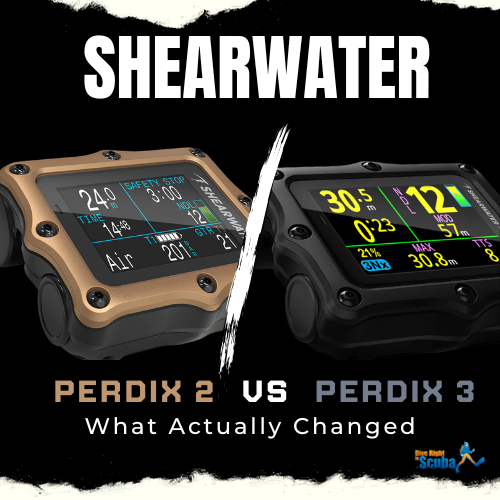
When Shearwater announced the Perdix 3, the scuba world collectively paused. The Perdix 2 has been the undisputed king of technical and advanced recreational dive computers for years. It is field-tested, bombproof, and trusted by everyone from deep cave explorers to weekend quarry divers.
So, how do you improve on a computer that most divers already consider perfect? And more importantly, if you already own a Perdix 2, do you need to upgrade?
We went through the spec sheets line by line. Here is the completely honest, hyper-factual breakdown of what stayed the same, what changed, and whether you should snag the new flagship or stick with the outgoing model.
What Stayed the Same
Under the hood, the life-saving capabilities and physical ruggedness of both computers are essentially identical. Shearwater didn't mess with the formula that made the Perdix legendary. If you dive both side by side, here is what you will find exactly the same.
-
The Depth Rating: Both computers are rated to a crushing 260 meters (850 feet).
-
The Armor: Both feature a precision-machined titanium bezel, an armoured casing, and titanium piezo-electric touch buttons that work flawlessly through thick dry gloves.
-
The Battery: This is a big one. Even with the new screen upgrades, the Perdix 3 still runs on a single, user-replaceable AA battery. Pop in a 1.5V Energizer Ultimate Lithium AA, and both models give you up to 60 hours of dive time.
-
Air Integration: Both computers support up to four wireless transmitters (like the Shearwater Swift) so you can monitor multiple tanks or side-mount setups.
-
The Brains: Both run the trusted Bühlmann ZHL-16C decompression algorithm with user-adjustable Gradient Factors. They also both feature intense vibration alerts and a 3-axis tilt-compensated digital compass.
What's New on the Perdix 3
While the physical ruggedness remains the same, the display technology and the software engine got a massive overhaul.
The Screen Technology and Size
The most obvious difference is the display. The Perdix 2 uses a 2.2-inch transflective colour LCD with a resolution of 320 x 240. It is incredibly efficient and easy to read in direct sunlight.
The Perdix 3 upgraded to a larger 2.4-inch ultra-bright AMOLED display with a resolution of 450 x 600. That is roughly four times the resolution of the Perdix 2. AMOLED means every individual pixel emits its own light, resulting in insanely crisp numbers, deeper contrast, and much better readability at extreme viewing angles or in pitch-black water. The lens on the Perdix 3 is also made from premium aluminosilicate toughened glass for extreme scratch resistance.
Any Mode Any Layout
On the Perdix 2, your screen layout is tied to your dive mode. The Perdix 3 completely decouples this. You now have three layout options (Standard, Big, and Tec) that you can use in any dive mode. Want to run your closed-circuit rebreather (CC/BO) but use the recreational "Big" layout with giant fonts? You can do that now.
Independent Setting Sets
If you switch between different types of diving, this is a game changer. The Perdix 3 allows you to save three completely independent configuration profiles. You can build a profile for single-tank recreational diving and another for your twinset technical rig. With a few button presses, you can swap between them, instantly changing your screen layouts, paired transmitters, and colour schemes.
Surface GF + 5 Metric
For the hardcore tech divers, the Perdix 3 introduces a new predictive tool. The Surface GF + 5 metric tells you exactly what your surface gradient factor will be if you stay at your exact current depth for five more minutes. It is brilliant for on-the-fly decompression decisions.
Dedicated Freediving Mode
While the Perdix 2 had a standard Gauge mode, the Perdix 3 adds a dedicated Freediving mode with highly configurable sampling rates and specific apnea alarms.
Next-Gen Bluetooth
Wireless log transfers on the Perdix 3 are now six times faster than the Perdix 2. Plus, the firmware is encrypted, and you can set a PIN code to prevent unauthorized connections.
So, Should You Upgrade?
So, let's answer the million-dollar question. Which one should you buy?
Hold onto your Perdix 2 if...
You have a perfectly working Perdix 2 and you have no trouble reading the screen. The Perdix 3 offers zero increase in battery life, depth rating, or fundamental safety algorithms. You would be paying over a thousand dollars for a crisper screen and some software tweaks. Keep diving your Perdix 2, it is still one of the greatest computers ever built.
Buy the Perdix 3 if...
You are buying your first "forever" dive computer, or you struggle to read your current screen in low visibility. The massive AMOLED screen and the new "Big" layout fonts are a genuine quality-of-life upgrade for your eyes. Also, if you frequently switch between recreational, sidemount, and rebreather setups, the new "Setting Sets" feature will save you a ton of menu-scrolling frustration.
The Bottom Line on the Perdix Evolution
At the end of the day, you cannot make a wrong choice here. Shearwater didn't replace a broken design; they simply added next-generation luxury to an already flawless platform. If you want the absolute sharpest, brightest display on the market along with effortless profile swapping, the Perdix 3 is worth every penny. If you just want a field-tested, bulletproof technical powerhouse and want to save some cash, the Perdix 2 remains an absolute steal.
Explore Dive Right In Scuba's full lineup of Shearwater computers and find the perfect brain for your next underwater adventure.